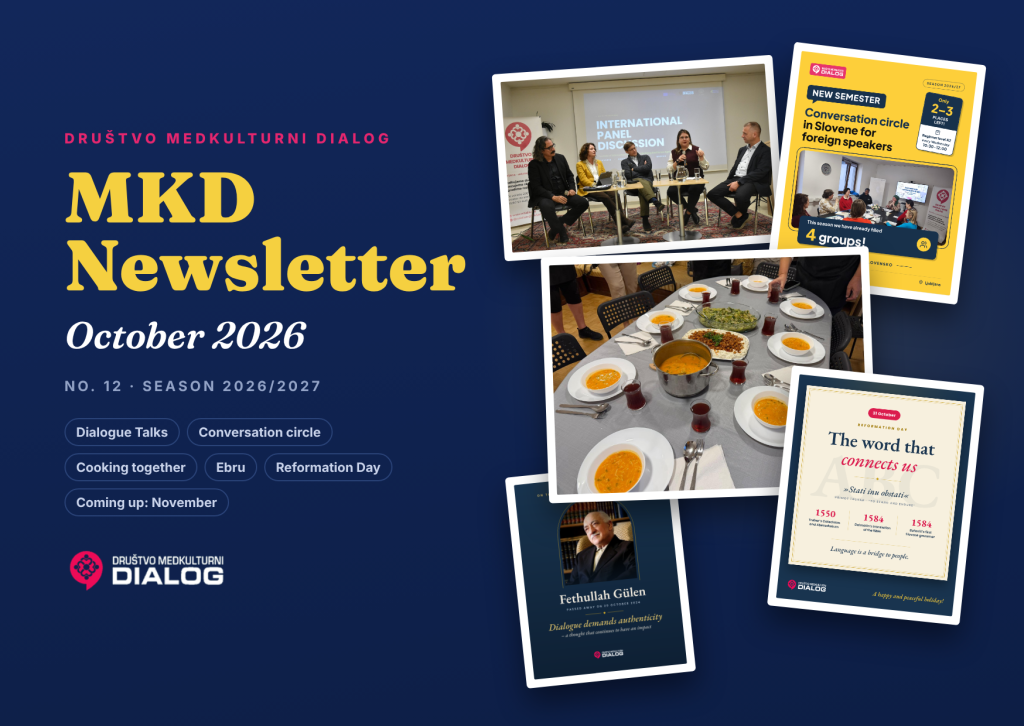
Dialogue Talks I: The Role of Intercultural Dialogue in Building Resilience Against Extremism
At the first Dialogue Talks panel, researchers from four countries explored how intercultural dialogue can build resilience against extremism, and showed that the most dangerous extremisms often hide where we least expect them.
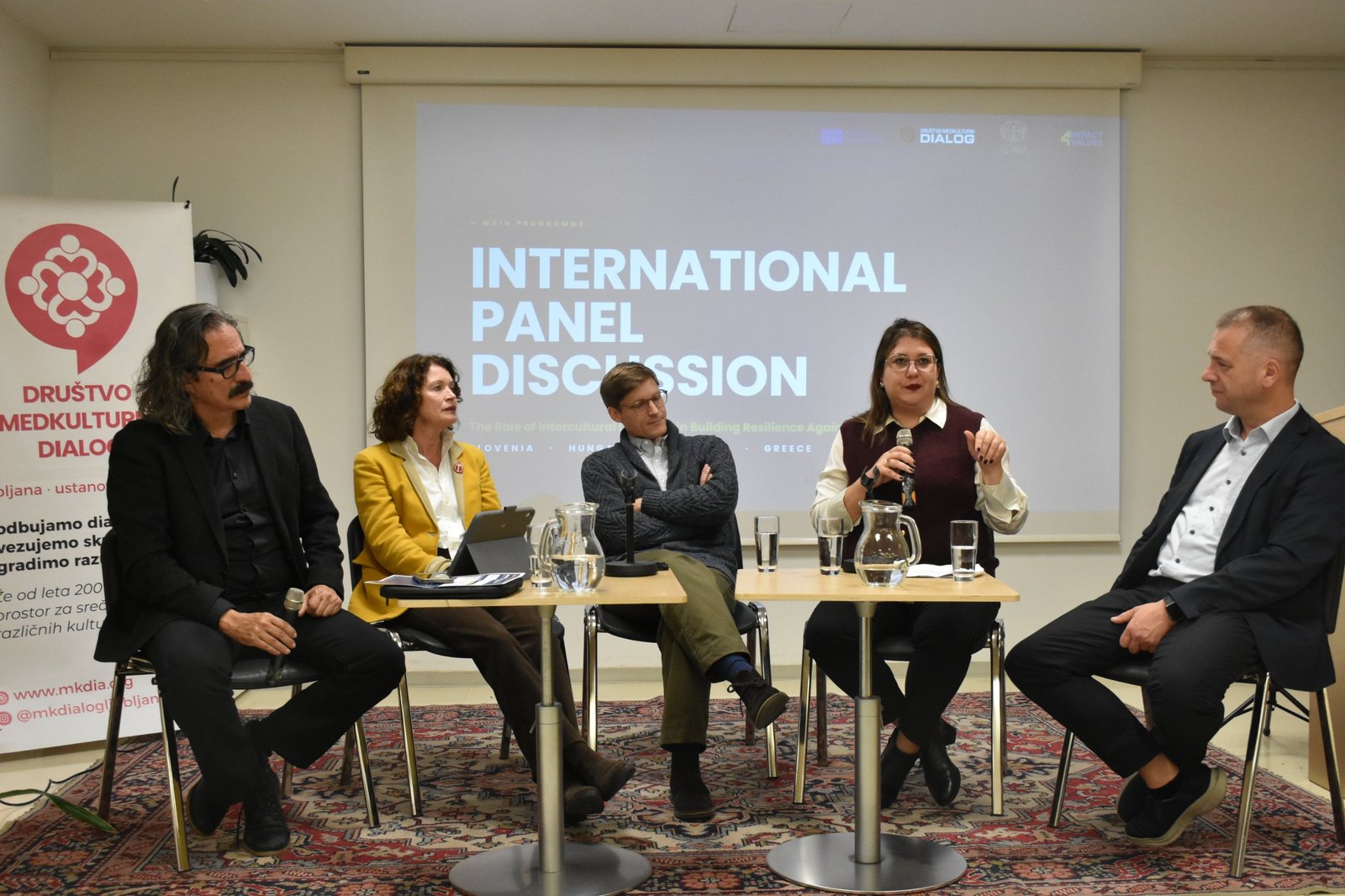
The evening opened with a musical welcome from Eva Jurgec and Uroš Jezdić. Moderator Carlos Pascual, a writer, essayist and theatre practitioner, then invited four guests to the stage. Each first set out their perspective briefly, the panellists then discussed with one another, and the final part belonged to questions from the audience.
The hall was full, and the audience wrote down so many questions that not all of them could be asked. Below are the thoughts that stayed with us.
Who was at the table
Assoc. Prof. Miklós Szabó
Cultural anthropologist and sociologist, head of the Department of Minority Studies at Eötvös Loránd University, Budapest
Assoc. Prof. Dr. Jozef Žuffa
Pastoral theologian at the Faculty of Theology, Trnava University, where he leads the cultural and religious mediation programme
Dr. Iralia Kotsakidou
Discourse analyst, postdoctoral researcher and adjunct lecturer at the Ionian University, Corfu
Assoc. Prof. Dr. Mirjam Milharčič Hladnik
Principal research associate at the Slovenian Migration Institute ZRC SAZU and associate professor at the University of Nova Gorica
Moderator: Carlos Pascual, writer, essayist and theatre practitioner
Watch the full discussion
Miklós SzabóWhich extremism are we talking about?
Miklós Szabó opened with a question that sounds simple but isn’t: how do we define extremism in the first place? He reminded the audience that 23 October is the anniversary of the Hungarian Revolution of 1956, which the communist regime of the day branded as extreme.
“Maybe we should not judge extremism by its distance from a political centre, but by how it affects our capability to live together.”
Miklós Szabó
As an example, he described Hungarian legislation that allows municipalities to stop people from buying property and settling in certain small communities. Officially it is about preserving local identity; in practice it is an unspoken exclusion of poor people and minorities. On the surface nothing about it looks extreme, yet in its effects it is more extreme than many a protest movement.
The most harmful extremisms, he said, hide well: in children’s games, in stories we consider innocent, in what passes for common sense. Drawing on research into intergroup conflict among chimpanzees, he noted that aggression happens where the aggressor feels safe. In complex societies, the key question is therefore what kind of behaviour we are made to feel comfortable and safe with, and what building blocks we give our children in school.
“Sometimes extremism becomes so widespread exactly because it has never been called out as extremism. It just becomes common sense.”
Miklós Szabó
Jozef ŽuffaListening without fear of losing yourself
At Trnava University, Jozef Žuffa and his students of cultural and religious mediation work on a skill that seems obvious: listening. It is not only about presenting your own view respectfully, but about hearing another story without being afraid of losing your identity, and without the inner evaluation that switches on in us automatically.
“Sometimes we don’t know that we are not listening until we experience what it means to really listen.”
Jozef Žuffa
He illustrated this with a personal story. One evening at home he consciously switched into “listening mode”, and his fifteen-year-old daughter talked to him for an hour and a half. Listening, he stressed, does not mean agreeing with everything: we can also set very clear boundaries. He added that Slovakia is a largely Catholic country, yet among those with the highest levels of extremism in Europe, which makes the relationship between religion and extremism a question we need to discuss openly.
Iralia KotsakidouWords are not just words
As a discourse analyst, Iralia Kotsakidou studies online hate speech, religious hate speech in particular. Online, users are both consumers and producers of content, there are no editors checking what is published, and anonymity creates a sense of impunity.
“You may say it’s just words. But it’s not. Words can lead to actions.”
Iralia Kotsakidou
With the moderator she also discussed how hate is becoming a business. Algorithms reward clicks, and a headline that stresses the perpetrator’s origin gets more of them than a factual account of what happened. She sees the answer in media literacy, in learning to filter what we read, and in listening and understanding. She also reminded the audience that economic crises have always gone looking for a scapegoat.
“Hate speech dehumanises people. It convinces us that others are not like us and do not deserve the same rights.”
Iralia Kotsakidou
Mirjam Milharčič HladnikThe stories schools don’t tell
Mirjam Milharčič Hladnik pointed out that one extremism always strengthens the other. After twenty years of round tables on dialogue, she finds that we mostly sit with people who think like us. That kind of conversation is pleasant, but it is not enough.
“Real resilience to all kinds of extremism is about a different, tougher kind of dialogue – with people who don’t think like me or you.”
Mirjam Milharčič Hladnik
Her main concern is education. The national historical narrative taught in schools is full of enemies, battles and expulsions. It is not wrong, but it is incomplete: missing is the history of connections, cooperation and love, of exchanging ideas, music, science, literature and food. The most powerful tool for understanding others, she said, is the personal life stories of ordinary people, which make us realise that the other is “almost like me”.
She added that European students still learn almost nothing about emigration from their own countries. Yet the history of migration is exactly what dissolves the myth of “pure blood” and shows that we are all connected.
From the audienceQuestions that remain
Questions from the floor were personal and direct. A participant who has lived in Slovenia for thirty years asked how we might “bury the hatchet”. Mirjam Milharčič Hladnik answered that we need ceremonies of reconciliation, like those some communities in Africa have: “We don’t have them in Europe. We have to invent them, at every level.”
A Turkish teacher asked whether national identity can be built on something other than stories of war. Milharčič Hladnik recalled Slovenia joining the European Union in 2004 and her dream of an inclusive European identity, a dream she feels has not yet come true – but pessimism is not an option. Miklós Szabó added that the key is to recognise our own suffering in the suffering of our neighbours, and mentioned Nobel laureate László Krasznahorkai, who says he loves being Hungarian but does not want to be only Hungarian; he wants to be European too.
Another participant spoke about how exhausting it is, as a Muslim woman in Europe, to keep explaining who you are every day, and how important it is not to close yourself off despite it. She also raised a question that remained open: why do social media, which were meant to bring people closer, so often spread hatred instead?
Quotes have been lightly shortened from the recording for readability.
Five thoughts that stay with us
- Judge extremism by its effects.What matters is how it affects our life together, even when it is quiet and looks “normal”.
- Listening can be learned.Listening without inner evaluation is a skill that changes relationships, and it does not mean agreeing with everything.
- Words lead to actions.Anonymity, algorithms and the hunt for clicks accelerate hate; media literacy slows it down.
- Schools need the other history too.Alongside wars and battles, the curriculum needs stories of connection, cooperation and migration.
- Dialogue has to leave the bubble.We need it most between people who disagree, perhaps with new ceremonies of reconciliation.
“I’m never pessimistic, because that’s not an option in our lives.”
Mirjam Milharčič Hladnik
Music as dialoguePaths of peace
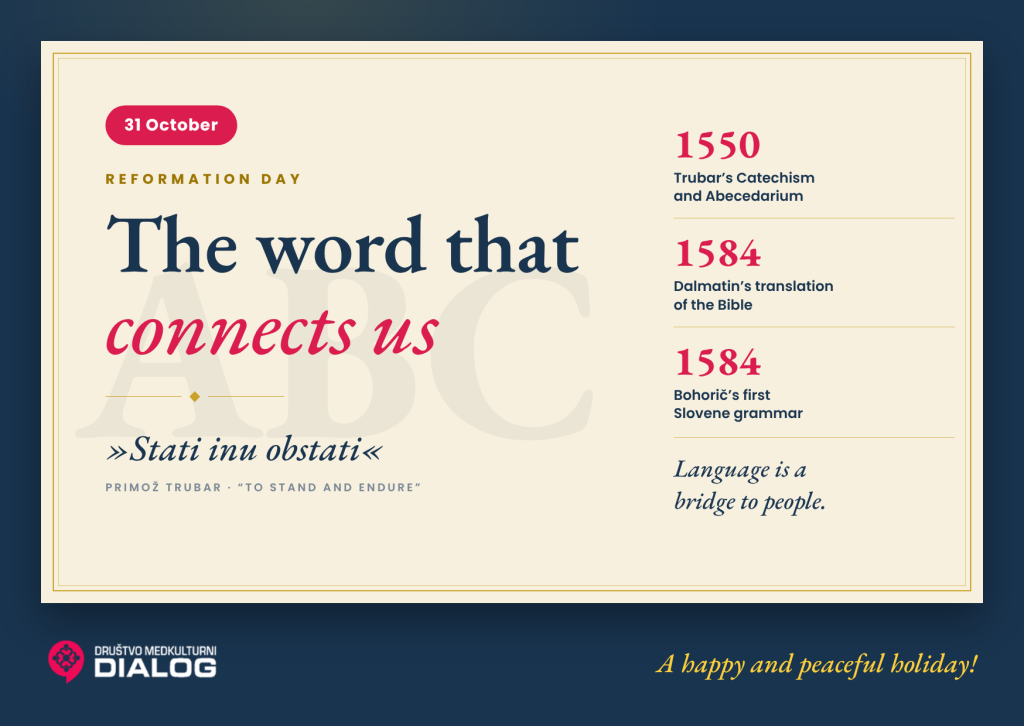
Eva Jurgec and Uroš Jezdić closed the evening with Slovene folk songs and dances from Prekmurje, Bela krajina and Carinthia. Introducing the Carinthian song “Kje so tiste stezice” (Where are those little paths?), they wished that we might walk the paths of peace and dialogue again. “Music is perhaps the best dialogue,” they added.
Moments from the evening
Dialogue Talks II · Greece
The series continues in Greece with a discussion on building resilience among young people. The third event will take place in Slovakia in spring 2027.
Thank you to our speakers, our moderator, the musicians, our partners from Hungary, Slovakia and Greece, and everyone who filled the hall.
The first Dialogue Talks event was held as part of the Impact4Values project, led by ADRA Slovenija. Co-funded by the European Union. Views and opinions expressed are however those of the author(s) only and do not necessarily reflect those of the European Union or the European Education and Culture Executive Agency (EACEA). Neither the European Union nor EACEA can be held responsible for them.