We celebrathe the World Hijab day on February 1st
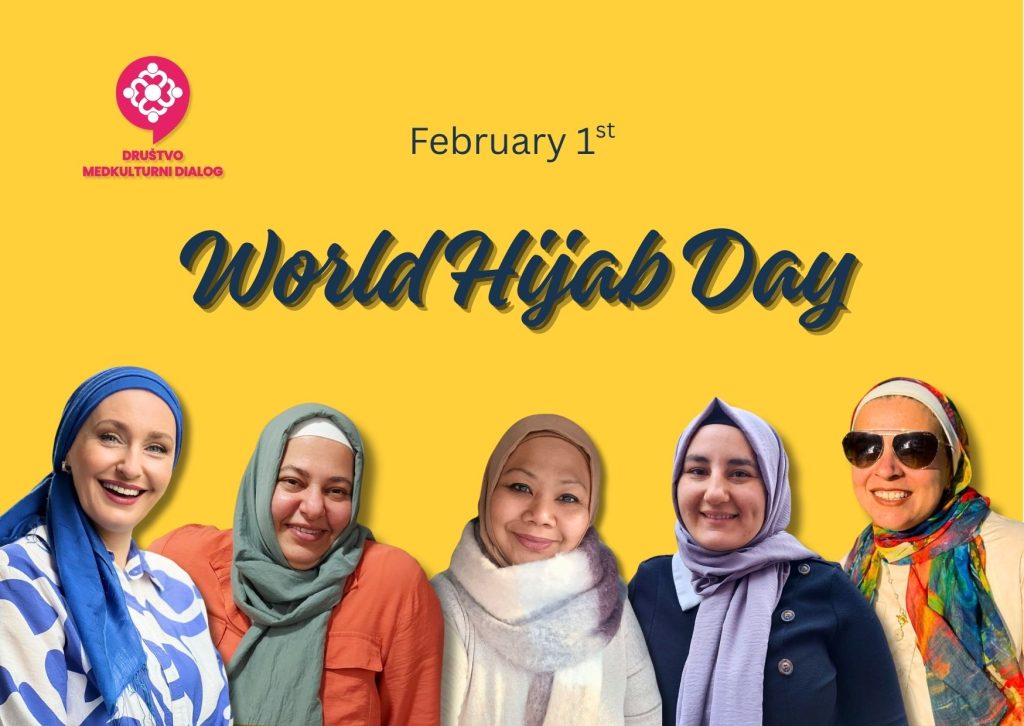
Today we celebrate World Hijab Day. The hijab is a head covering worn by Muslim women around the world. Discussions about headscarves and shawls are always accompanied by questions of free choice, dignity, and respect for diversity. For many women worldwide, the hijab is not merely a piece of clothing, but an expression of faith, identity, and a personal journey. Every story is different, every decision is personal.
On the occasion of World Hijab Day, we have decided to share the stories of five women—Muslim women—who feel empowered by wearing their head covering. We are sharing these stories in the spirit of interfaith dialogue.
We believe that this day, within the Slovenian public space, offers an opportunity to reflect on acceptance, understanding, and coexistence in a diverse society. Open dialogue, listening to the experiences of others, and respect for religious freedom are the foundations of an inclusive community in which everyone has the right to be who they are.
We invite you to read five testimonies of women from different cultural backgrounds and with different life stories.

Azra
I first dreamed about the hijab for two years. I still get pleasant goosebumps when I think about it. I come from a Slovenian–Montenegrin family, yet the attitude toward covering among my Montenegrin relatives was very negative. I covered myself in 2007, when I was 30 years old.
I put on the headscarf for the first time at a special event during Eid al-Adha. My friend from Turkey, who had been teaching me about Islam, began to cry with happiness when she saw me wearing the hijab. From that day on, I never took it off again.
During the 6 years of living in Turkey with my husband and children, I wore the headscarf in the way Turkish women do. When I returned to Slovenia, I noticed that the atmosphere had changed significantly. I experienced very negative reactions and confrontations. I must admit that, as a result, I changed my style and now cover myself differently.
The hijab is not just a symbol of Islam; for me, it represents faith in my God. It represents fundamental values and my devotion to God.
I leave the choice to my daughters. When they were growing up in Turkey, I naturally wished that they would cover themselves. In Slovenia, in the current situation, this is difficult. At home, we always emphasize the importance of values, and every day I am proud of them for the decisions they are already making.

Sally
I am very happy to be able to share my story. This is not an easy topic, especially in Slovenia, where we mostly talk about negative experiences. I grew up in Egypt, where there is no discrimination and no coercion—at least I did not experience that in my family. My mother put on the hijab when she was older than 40. I wanted to start wearing it in high school, but my mother told me that I might not be ready. She advised me to wait a little longer, even though I told her that I felt I wanted to wear it.
I therefore started wearing the hijab at university; I remember it was the first day of Ramadan. I had many friends who also wore headscarves, as well as many who did not. In Egypt, the hijab is not a difficult decision because there is no societal pressure. It is also worth mentioning that public spaces are adapted for women who cover themselves: women-only beaches, gyms, and fitness centers with women-only hours.
The hijab does not represent a burden for me. It has become part of my identity. When I moved to Slovenia with my husband and children, I received many comments such as, “Why don’t you take off your headscarf now that you are in Europe?”
These questions hurt me because I see the misconception among people who believe that Muslim women are forced into this. Despite all the challenges I face here with wearing the hijab, I still feel empowered.
Although I could talk about many reactions—or at least the staring—that I noticed at the beginning outside in publice spaces in Slovenia, I am proud to observe that the hijab also brings me positive interactions. Other Muslim women greet me with a smile, and sometimes I receive a greeting like “Ramadan Mubarak,” which truly makes me happy.
My style of wearing the hijab has, of course, changed a lot since my teenage years in Egypt. In Egypt, I tied it in a traditional Egyptian way, then for several years in Dubai in a different way, and now again differently here in Slovenia.
I have two daughters. Because I had the freedom of choice while growing up, I believe this must apply to every girl and woman. The hijab is not just a piece of fabric. It is a great responsibility, and you have to be strong enough for it. My daughters will always have the freedom to make this decision on their own. The hijab comes as a package with other feelings and faith that you truly have to feel. It is a special bond with God. When you are ready for this step, everything is possible. The decision to wear the hijab must never be made under pressure. My daughters have and will always have my full support, whatever their decision may be.

Seda
I started wearing the hijab when I turned 12 years old. My classmates also wore the hijab and I liked it. I felt good, and that is why I started wearing a headscarf. I went shopping for colorful scarves with my mother. Every day I wore a different color. The hijab is part of my Turkish and Muslim identity.
Today I am a mother of two daughters, so I no longer have as much time for fashion. I no longer own many patterns, but I still feel good wearing the hijab. With less striking colors, I also do not want to attract too much attention. I never have a “bad hair day.” I do not need to spend time on hairstyles to impress others, yet I can still feel comfortable and well put together. This does not mean that I do not take time for self-care. With the demanding pace I have with children and work, the hijab saves me time and ensures my comfort.
I believe it will not be easy for my daughters to start wearing the hijab here in Slovenia. Maybe when they are older. That will be their choice. All I can do is set an example.
I am glad that I can share my story on World Hijab Day.

Nesrin
I first put on the hijab at the age of 16. Even before that, I had wanted to wear a headscarf for several years. I felt that it would help me grow closer to God. I do not have sisters, so my only role model was my mother. My family never forced me to wear the hijab. Many of my aunts, for example, did not wear it.
In my final year of university, a ban on the hijab was introduced in academic spaces and all public government institutions. I decided to wear the hijab everywhere except during lectures at the university. After I graduated, I still felt pressure even in private companies due to political attitudes toward wearing the hijab. As a result, I did not wear a headscarf for several years.
I married a man who knew that I wanted to wear the headscarf. I chose a partner with whom I share the same values and faith in God.
After a few years, I found a job where this pressure was no longer present, and since then I have not taken off my headscarf.
Wearing the hijab is my path. At times, I experience it as a greater challenge because of social pressure, both in Slovenia and in Turkey. Although the choice to wear the hijab is not easy, I do so because of my faith in God.
When I get ready at home and prepare to go out, I enjoy choosing color combinations. I always think about complementary colors and take pleasure in putting together a complete outfit. Like any woman, I like to feel well put together, and when I wear carefully chosen colors, they influence how I feel. I like to feel beautiful.

Marliza
I first put on the hijab during my first pilgrimage to Mecca (Hajj), when I was 30 years old. My sister and I went on Hajj together. We had prepared for the journey and the rituals that awaited us, but when I saw such a large number of Muslims gathered near Mecca in Mina and Arafah, I was truly speechless. There I witnessed the sight of all the pilgrims, as far as my eyes could see, and I was truly humbled.
When I returned to Malaysia, for several weeks, I did not start wearing the hijab, but I felt different. I felt good wearing it while performing Hajj —it felt like a part of me. Back in Malaysia, I gradually came to the realization that I had experienced a spiritual transformation.
Only then did my spiritual journey truly begin and I began wearing the hijab. As born muslims, we had learned about Islam at school as children, but as an adult, I wanted to understand and enrich my knowledge in Islam. I enrolled again to complete my Diploma and Master’s in Islamic Studies.
Today, I feel that the hijab is a part of me. I recently moved to Slovenia with my Slovene husband and our daughter. My husband’s sister, who is non-muslim, asked me whether I would now take off my headscarf in Slovenia, since I am no longer in Malaysia. I smiled and explained to her that I do not wear it for other people, but for God.
When I shop for headscarves and shawls, I plan how they will match my clothes. Over the years, my way of wearing the hijab has changed. I can say that I have experimented with different styles, prints, materials and thicknesses of scarves. The hijab is both the first and the final step in planning my overall appearance, together with clothing, shoes, and accessories. The choice of colors and patterns certainly influences—and reflects—how I feel.
I would also like to add that the hijab is a personal matter. It is a personal journey that accompanies you everywhere. We should not judge others or their spiritual paths, for example when some girls and women take off their hijab. I believe that only God can judge that. We should always try our best to follow Islam as Prophet Muhammad saw has lead/guide and stay within our faith (iman).My daughter often compliments me on how nice I look. I also enjoy hearing compliments from other people too, some out of curiousity of how my hair is. For my daughter, I wish that she will follow her own spiritual path. I believe she will encounter her own challenges. Whether she will wear the hijab will be her decision.
The testimonies were written down for the MKD Association by Miša Bitenc Hernčič.